
For Clinicians
Together in Care and Discovery
Our clinician community plays a vital role in early diagnosis, treatment innovation, and compassionate care for every Alström family.
Alström Syndrome is a rare genetic disease that affects many parts of the body. Alström Syndrome is named for a Swedish doctor, Carl-Henry Alstrom, who first described it in 1959. Alström Syndrome is caused by a change in a gene, called ALMS1. Below are some explanations of the symptoms that people with Alström Syndrome can have. It is important to know that NOT ALL people have ALL of these symptoms and Alström Syndrome is extremely variable!
What is Alström Syndrome?
Clinical Resources & Guidelines for Alström Syndrome Care
Alström Syndrome Handbook
The handbook is full of practical, evidence-based guidance for diagnosing, monitoring, and managing this complex multi-system disorder to support coordinated, proactive care.
Consensus Care Guidelines
Consistent care is key to better outcomes in Alström Syndrome. These Consensus Guidelines provide a unified framework for monitoring, coordination, and managing complications.
Clinical Features
This section outlines the characteristic clinical features and variable manifestations of Alström Syndrome across multiple organ systems.

How to Diagnose
Alström Syndrome is a rare genetic disorder. It is diagnosed through genetic testing. See the links below to visit the NIH sites for Genetic Testing and Alstrom Syndrome.
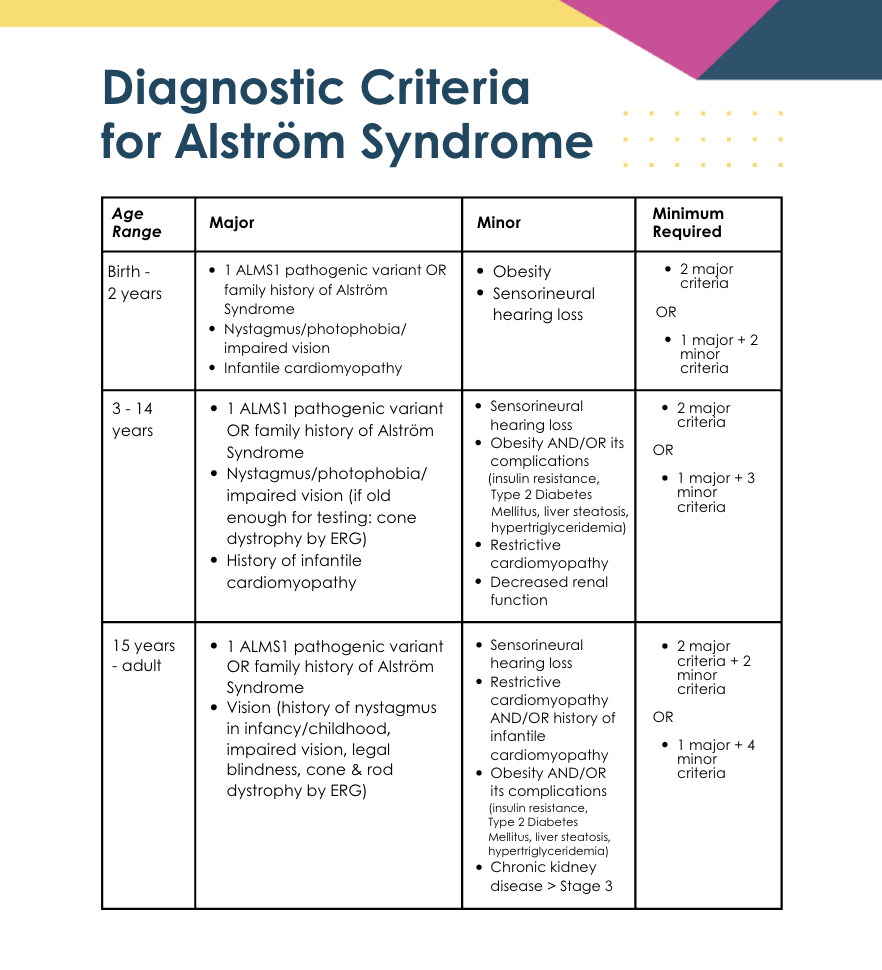
Diagnostic Criteria
Alström Syndrome is characterized by a very complex interaction of progressive, highly variable symptoms, many of which are often viewed as NOT related to the syndrome, but they frequently are!
The cardinal diagnostic features described in the medical literature are the combination of early retinal degeneration, hearing impairment, childhood obesity, respiratory dysfunction, endocrine and urologic disorders, cardiomyopathy, extreme insulin resistance, accelerated non-alcoholic fatty liver disease, renal failure.
Delay of onset of some of the characteristic features (type 2 diabetes, cardiomyopathy, liver disease, and kidney failure, for example) makes differential diagnosis very difficult, especially in young children. Many of the manifestations do not become apparent until after the teenage years. As the child grows, the characteristic pattern of Alström Syndrome evolves and the clinical picture becomes clearer. Therefore, the most recent advice concerning diagnostic criteria takes into account the age of the child as well as the symptoms that the child exhibits.
Frequently Asked Questions
-
Alström Syndrome is an ultra-rare, autosomal recessive ciliopathy caused by pathogenic variants in ALMS1. It is characterized by progressive multiorgan involvement, including retinal dystrophy, sensorineural hearing loss, cardiomyopathy, metabolic dysfunction, and systemic fibrosis. Diagnosis is best confirmed through molecular genetic testing. Clinical suspicion should increase when multiple system involvement presents early in life.
-
Common early features include:
Cone-rod dystrophy with nystagmus and photophobia in infancy
Progressive sensorineural hearing loss
Dilated or restrictive cardiomyopathy
Severe early-onset obesity, insulin resistance, or type 2 diabetes
Other presentations may include developmental delay, hepatic dysfunction, or renal impairment. Symptom expression and progression vary significantly.
-
There is no curative therapy. Management is multidisciplinary, with routine surveillance and early intervention for cardiac, metabolic, hepatic, renal, endocrine, and ophthalmologic complications. Evidence-based care is focused on reducing morbidity, slowing progression of organ dysfunction, and supporting functional development.
-
Recommended care team composition includes:
Primary care physician overseeing integrated management
Cardiology (cardiomyopathy surveillance and treatment)
Endocrinology and metabolic care
Ophthalmology and audiology
Hepatology, nephrology, nutrition, and pulmonary support
Access to rare disease clinics with experience in ciliopathies is ideal.
-
Structured nutrition and physical therapy programs
Early and ongoing speech, occupational, and mobility therapies
Proactive glucose and lipid control to mitigate cardiometabolic burden
These interventions may slow disease progression and maintain functional independence.
-
For patients with Alström Syndrome admitted to the hospital or outpatient facilities, even if for routine minor surgery, it is vitally important that medical and nursing staff is aware that hypoxia (low blood oxygen levels) can occur very rapidly in patients with Alström Syndrome. In some patients, this has led to life-threatening heart/lung problems because of the reduced reserve capacity of the cardiorespiratory system. Please use all precautions for monitoring oxygen saturation.
-
Alström Syndrome International provides:
Family support and patient education resources
Sibling programs
Regular international family and research conferences
Clinicians are encouraged to refer families early to reduce isolation and improve care navigation.
-
Enrollment in the Alström International Patient Registry
Referral to clinics with expertise in multisystem genetic disorders
Access to validated educational materials
Shared decision-making and proactive care planning are essential due to progressive disease course.
-
Email science@alstrom.org
Resources
Find more valuable information on Alström Syndrome here.



Meet Our Scientific Board of Directors
Our Scientific Board of Directors brings together leading experts to guide research priorities, ensure scientific rigor, and advance understanding of Alström Syndrome.
Do you have questions about Alström Syndrome? Get in touch with our team to discuss more.